Online stores
Selection without immediacy.
The book can be found, but the reading moment may be gone before it arrives.
A Paralloff product
Physical–digital reading infrastructure
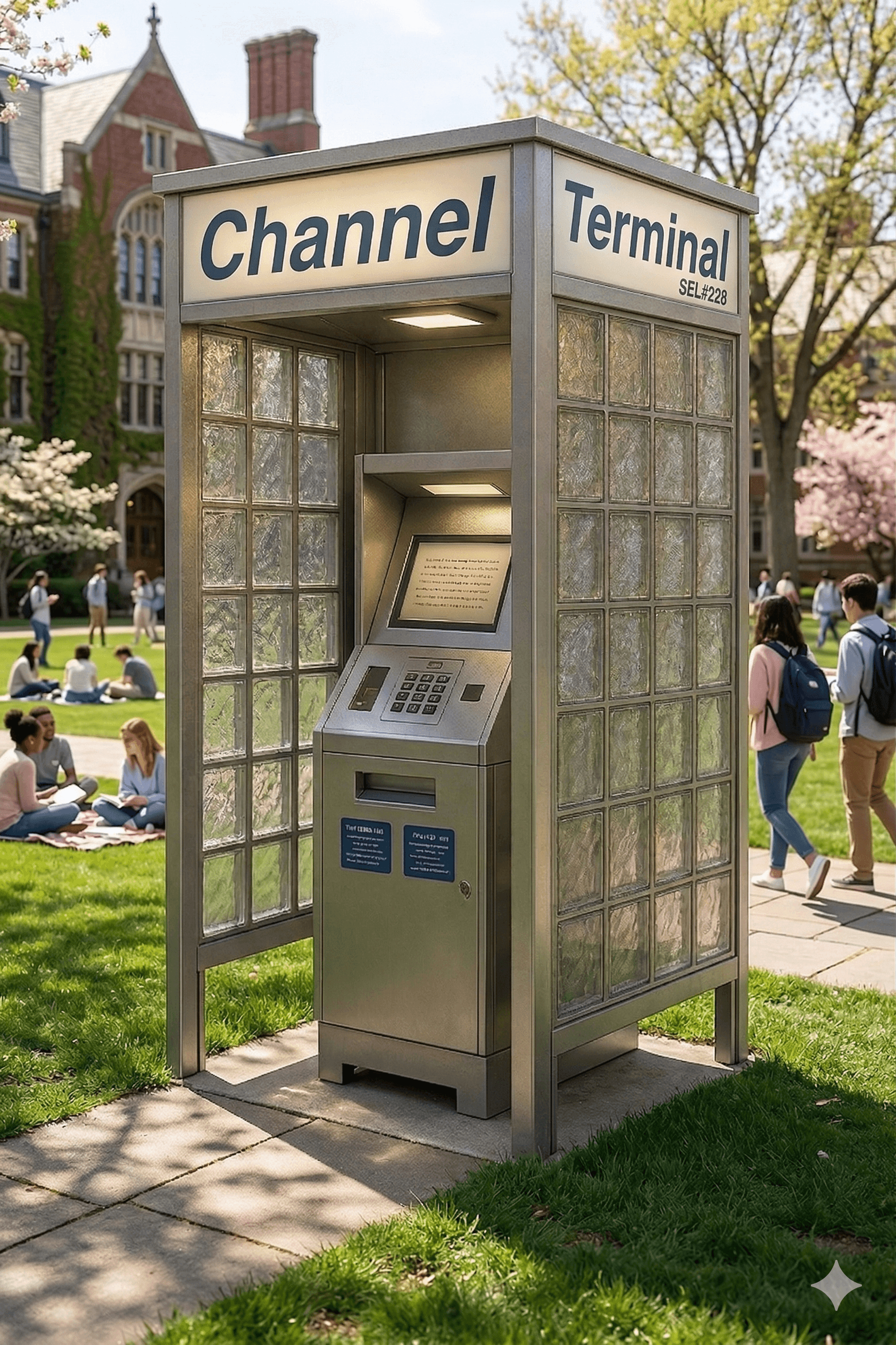
Channel is a campus-first physical–digital reading system in development at Paralloff. A compact Access repeatedly makes Channel visible on the route; the app owns book discovery, selection, payment, and management; the Access outputs the selected physical reading copy where students already study and move.
Planned first pilotMultilingual OER and course-linked readers · 1–3 Access units · one campus
Why Channel
Online stores offer selection, but not physical immediacy. Ebooks are immediate, but compete inside the same screen as everything else. Bookstores and libraries offer rich experiences, but usually require a deliberate trip.
Channel is designed for the short window between “I should read” and the moment that intention disappears.
Online stores
The book can be found, but the reading moment may be gone before it arrives.
Ebooks
The text is available, but it remains inside a highly competitive screen.
Bookstores & libraries
They are powerful destinations, but not always where the reading impulse appears.
The bottleneck is contact, not supply.
Our why now
01 / SCARCITY SHIFT
AI can retrieve, summarize, translate, and generate text at very low cost. The scarce work is choosing which original work deserves direct attention, knowing where an idea came from, and forming a judgment that belongs to the reader.
Channel is designed around that shift. AI can help a reader enter the source. The source remains visible. Any future reading record would remain under the reader's control.
How Channel works
A Channel node combines a compact physical advertising and output Access with an app-first book and continuity layer in places people already pass through.
Encounter a visible Channel Access on a repeated route. Its persistent physical presence advertises Channel and the fact that a reading object can be output here now.
Discover, compare, receive recommendations for, search, select, pay for, reserve, and manage books in the app. Device-side quick-pick is only a fallback.
The Access confirms the app order and outputs the selected physical copy for pickup without making you leave the route you are already on.
Keep access to the reading object, reprint it when useful, and return to the next session. Over time, notes and questions can remain connected to the source under the reader’s control.
The first wedge
The first Channel pilot focuses on international students who face three connected frictions: understanding course-linked and technical material, turning it into a usable physical format, and annotating it without losing the original source.
AI assistance remains source-visible. High-stakes professional translation is outside the initial product promise.
The first pilot
The first pilot is intentionally small. The goal is not to present a finished citywide network. It is to test whether a well-placed physical node can advertise Channel, create app entry, and let the app-to-output chain convert a real reading moment into repeated use at a defensible acquisition cost.
The Channel compounding hypothesis
This is the operating thesis behind Channel, not a growth engine we claim to have proved. The first pilot is designed to isolate the links one by one.
Compact Channel nodes appear on repeated routes where students already wait, study, and move.
Persistent physical advertising can create Channel recall and app entry; app choice must then convert into Access output, pickup, and revisit.
Real demand can improve placement, language options, catalog mix, uptime, and servicing routes.
Reliable operations and transparent attribution can give campuses, authors, and rights holders evidence they can evaluate.
Stronger site and rights relationships can add better locations and more authorized material, increasing the value of the next encounter.
↺ Returns to step 1.
What each scale must prove
Public operating model · The full site-selection, rights, economics, and implementation models remain internal.
Long-term vision
Where there is meaningful output from the human, there must first be rich input to the human.
Original works enter through reading, pass through human attention and thought, and can become questions, judgment, interpretation, purpose, and authorship.
Highlights and questions are downstream human outputs. Only records a reader chooses to retain can remain anchored to the source—without treating private thought as extractable data.
A translated or explained passage stays anchored to the source. The reader can see where it came from, mark it on paper, and choose what continues.
Original work · question retained · continuity by choice
AI can explain, connect, and translate, while the source remains visible, traceable, and attributable.
Highlights, questions, and reflections remain private by default and stay under the reader's control.
Channel uses AI to help people enter, continue, and revisit original works—not to make reading unnecessary.
Building the first loop
Campus & space
A visible location with repeated routes, meaningful dwell time, and a team willing to run a bounded pilot.
Content & rights
Open-license, OER, instructor-approved, author-approved, or pilot-licensed material with clear attribution and use boundaries.
Hardware & print
Compact enclosures, secure access, printing, binding, device integration, and field operations.
Early builders & advisors
People who can own a hard problem across software, hardware, publishing, operations, or spatial design.
Founder
Daehyung Lee is the founder of Paralloff and a Purdue ECE alumnus. He is leading the product architecture, physical–digital system design, and first-campus-pilot design and preparation.
Paralloff is building the early team through focused collaborators across hardware, software, publishing, operations, and spatial design.
The next proof
If you can help host, build, supply, or evaluate the first Channel pilot, let’s start a conversation.
Prefer email? dae@paralloff.com